Ad fraud will cost marketers $84 billion this year – 22% of all online ad spend.
This figure is expected to soar to $170 billion in five years’ time in 2028, according to a new in-depth study from Juniper Research.
Why we care. Ad fraud could be costing your brand money, hurting campaign results, leaving you with fewer genuine leads and poor advertising ROI. With this in mind, it may be worthwhile exploring fraud-blocking technology or reallocating some of your ad budget to your SEO strategy.
Key findings. Juniper’s study analyzed digital advertising in 45 countries across 8 regions, using a dataset of over 78,700 data points from 2019 to 2028. The research found that:
22% of all online ad spend is lost due to ad fraud in 2023.
30% of mobile ad spend is lost to ad fraud in 2023.
$172 Billion of ad spend is projected to be lost due to ad fraud by 2028.
$23 Billion per year can be recovered by using fraud mitigation platforms.
Solution. Fraud detection technology, such as Fraud Block, can detect and identify fraudulent or invalid traffic, impressions, clicks, or conversions on ads, helping to protect your campaign performance and ad budget.
What has Juniper Research said? Senior Research Analyst from Juniper Research, Elisha Sudlow-Poole, said in a statement:
“Data provided by popular ad platforms, such as Facebook and Google, provide an incomplete picture of the success of advertising campaigns.”
“That is, these platforms give an optimistic view of campaign efficiency, failing to distinguish between how many clicks or views originated from legitimate users compared to click farms or fraudulent bots.”
Deep dive. Download the full report by Juniper Research for more information.
Advertisers have been encouraged to reevaluate their match type and bidding strategies to effectively optimize costs and maximize campaign performance.
The advice was published in a new report conducted by Optmyzr that investigated broad match type vs exact match type.
Although researcher and Optmyzr evangelist Navah Hopkins previously strongly supported broad match in favor of exact match type, the study found that exact match outperformed broad match for the majority of accounts in terms of:
Cost Per Click.
Click Through Rate.
Cost Per Acquisition.
Return On Ad Spend.
Conversion rate.
Why we care. For advertisers, it’s crucial to test new strategies in your campaigns before making decisions. This ensures enhanced performance. Evaluate costs and adjust your approach based on budget and targeting goals, exploring more cost-effective networks or top-of-funnel options to optimize spending.
The study. The Optmyzr report analyzed 2637 accounts to compare the effectiveness of broad match type versus exact match type. Additionally, we examined Maximize Conversions against Maximize Conversion Value in 1,334 accounts due to their close association with smart bidding.
The results. Key findings from the study reveal:
Broad vs. Exact Match:
In most cases, exact match performed better in terms of CPC, CTR, CPA, ROAS, and conversion rate.
Conversion-oriented metrics like CPA and ROAS also favored exact match.
If broad match is doing well, it’s advisable not to make major changes. However, testing for potential benefits is worth exploring.
Maximize Conversions vs. Maximize Conversion Value:
Maximize Conversion Value performed better in terms of CPC, CTR, CPA, and ROAS for most accounts.
Max Conversion Value had cheaper CPC, possibly due to bid caps and practical ROAS goals.
CPA was generally better with Max Conversion Value, challenging the belief that higher CPA can lead to higher-value customers.
The data also recommends using Max Conversion Value and determining conversion value based on customer value and channel conversion rates.
Key takeaways. The study concluded by advising advertisers to:
Test your assumptions and don’t just accept common wisdom without questioning it.
Make sure you’re always checking in on your accounts and tweaking your bidding strategies to get the most bang for your buck.
Ensure you’ve got your safety nets in place and budget set aside for data acquisition, if you’re going to give broad testing a shot.
Get the daily newsletter search marketers rely on.
What has Optmyzr said? Navah Hopkins, Optmyzr Evangelist, said in a statement:
"The biggest takeaway from looking at the data is not taking anything for granted. Just because we’re told X is true, it’s important to test and prove whether it’s viable in our accounts before committing to it or discarding it."
"Additionally, given that the conventional wisdom of Exact and Max Conversion Values are more expensive because they provide more value that didn’t play out at scale, it’s worth doing a deep dive into your accounts if they are driving up your costs."
"Consider being more aggressive with negatives and exclusions, as well as owning whether you have the budget to go after desired transactional traffic or if you’d be better served leveraging your budgets on cheaper networks (Microsoft) or top of the funnel (PMax, social, video)."
Deep dive. Read the Optmyzr report in full for more information.
Most SEOs know the difference between short-tail and long-tail searches. In local SEO, we take it further by giving these search term types another name: implicit and explicit searches.
Applying this concept to your local search strategy can help improve your local rankings and drive leads from Google Maps with arguably less effort. Here’s how knowing the difference can help you get better results in local search.
Implicit vs. explicit search in local SEO: How do they differ?
An explicit search is a search where the user adds a location in their search phrase, such as “car accident lawyer Philadelphia.”
While an implicit search is when the user does not add a location modifier to their search phrase, such as “car accident lawyer.”
Simply put:
An implicit search is a short-tail or general search.
An explicit search is a location-modified, long-tail search.
Google can show radically different search results depending on the location modifier a user adds to their search and the user’s physical location at the time of the search.
Generally, this difference is less prevalent in organic SERPs.
In Google Maps search results, however, the difference between an explicit vs. implicit search is more stark and an element every local SEO must pay attention to.
Why do implicit and explicit searches matter?
One search type is much easier to rank and optimize for than the other. This is due to how Google treats local search results based on their local ranking factors.
Google continually aims to deliver the best search results by considering a combination of these key factors:
Relevance: How well a business matches the user’s search intent. Google uses a mix of information the business provides on its Google Business Profile (GBP), website and other online sources.
Distance: The business location’s proximity in relation to where the user is searching. This comes into play less with explicit searches compared to implicit and “near me” searches.
Prominence: How well-known the business is online and offline. This includes review count and rating.
Relevance and prominence are factors we can more or less influence with marketing efforts. Distance is a fixed factor that we cannot change unless we physically move the address of the business – something most businesses are less than willing to do.
While relevance and prominence are important, proximity to the searcher is the top local search ranking factor, beginning with the 2016 Possum update. As such, ranking for implicit keywords across a large service area or in a competitive city is virtually impossible.
This changes when a user adds a location modifier to their search, as Google will not use a user’s location as the center radius for the particular search.
Instead, Google will use the center point of the location added to the search as the center of the search radius.
This makes the proximity/distance factor less influential and allows you to strategically go after various keywords.
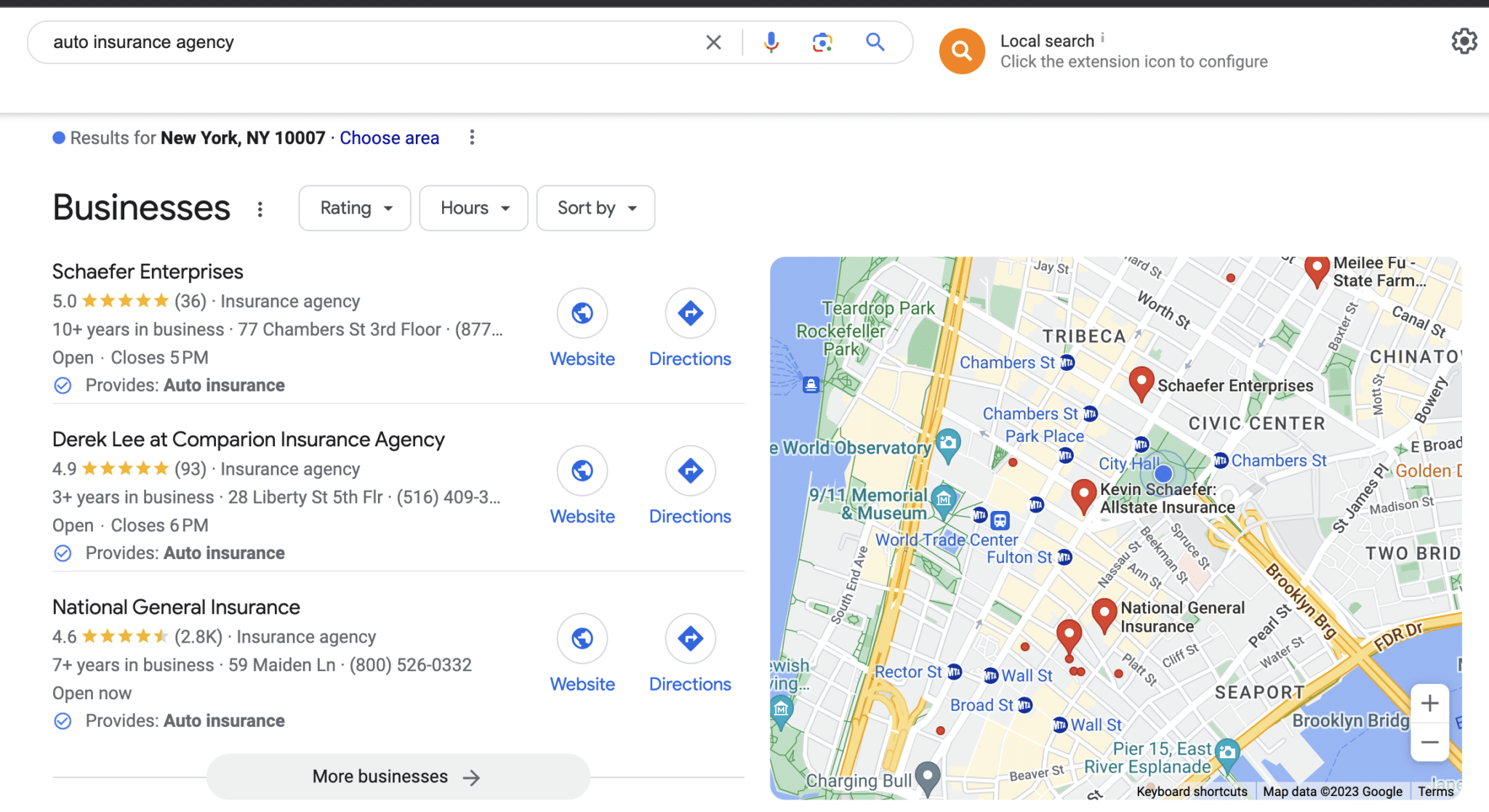
See the examples below of a search for “auto insurance agency” vs. “auto insurance agency new york.” (My location extension is set to ZIP code 10007 for both searches.) The results differ significantly.
“auto insurance agency”
“auto insurance agency new york”
Figuring out which keywords you can dominate by using this key metric
Now that we know Google ranks businesses differently based on where the search is done and whether location modifiers are used, let’s dig into how you can effectively strategize your local SEO with this information.
I use Share of Local Voice (SoLV), a metric for determining “how frequently your listing shows up in the Map Pack per a given scan radius. The greater the SoLV, the greater your local search visibility,” according to Local Falcon’s website.
With SoLV, you can effectively determine how well your business dominates the market for your target keywords. You can also do this for your competition to see how well they dominate the market for your target keywords.
This is an invaluable metric that can show you what is actually possible when it comes to opportunities for local ranking and traffic improvements for all your keywords in your given market.
Get the daily newsletter search marketers rely on.
I once had a locksmith client who was obsessed with ranking for the term “locksmith” because it has 10x the search volume of the explicit versions of the keyword, like “locksmith near me” or “locksmith [city]”.
The U.S.-based client was located in the middle of a major metropolitan area, surrounded by tons of competitors, in an already competitive industry. Talk about a trifecta.
Though the client was technically correct about the search volume, as a seasoned SEO, I knew there was no way we would dominate map rankings in their city for “locksmith” with just one GBP listing, no matter how hard we tried.
He was far from convinced and insisted we not ”waste time” with low search volume keywords when his listing was barely ranking for “locksmith” across his service area.
This caused us to investigate how many opportunities there actually was for their listing to improve for “locksmith”.
We looked at their biggest competitors in the market and found that none of them could dominate the market for “locksmith” with one GBP listing.
Below is the SoLV for “locksmith” for our client vs. their top competitor.
The competitor's SoLV
The client's SoLV
The screenshots show limited room for growth as the top competitor has one more green pin than him. In reality, that’s not enough of a growth opportunity.
To double down on unrealistic expectations, the client was also insistent we increase leads by 20%, a lofty goal we could never hope to achieve if we just went after “locksmith.”
Thus, we pivoted to optimizing their GBP and website for less competitive keywords like “locksmith [city]” and “emergency locksmith.”
We did this largely through:
On-site optimizations for long-tail keywords.
Optimizing the categories and services on their GBP listing.
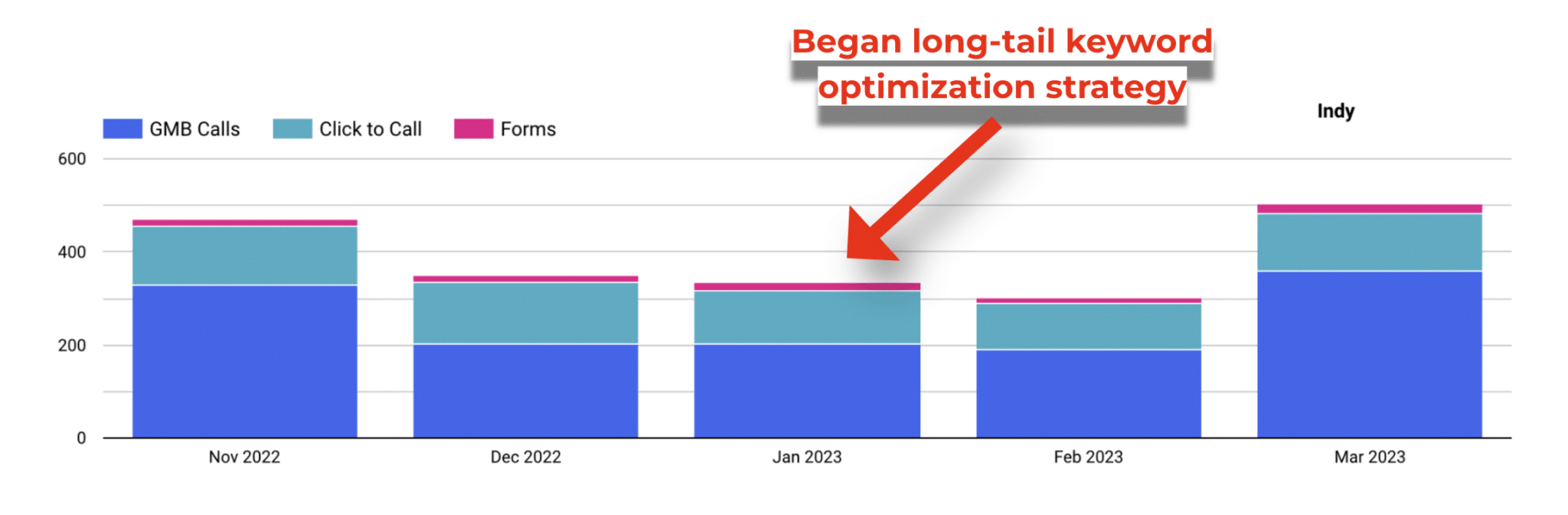
From this long-tail strategy, we saw major success. Not only did their rankings for the explicit versions of his head keyword go up, but so did the number of calls they got from their listing.
Putting all this into practice
Share of Local Voice is an invaluable metric that can help estimate the true possibilities for improvement for any local keyword.
I’ve encountered many clients who are not local SEO-savvy, and by showing them the maximum SoLV, we are better aligned with the potential impact of local SEO efforts.
Relationships are immensely better when you set data-backed expectations from the start.
Instead of constantly chasing an unachievable unicorn, shifting to an explicit, long-tail keyword strategy can truly impact their bottom line. Education is key here.
Our job as SEOs is to educate and guide our clients, as their time should be spent running a business, and they can't possibly know all of the ins and outs of our ever-changing industry.
So instead of throwing mud at the wall and hoping it sticks, take a look at what explicit keywords you can be targeting for your listings and work towards optimizing for those.
The best part? Optimizing for explicit long tail keywords does not conflict with optimizing for implicit head terms.
Optimizing content is not a zero-sum game. By focusing on increasing visibility for the keyword we knew we could improve, we could make improvements to all the most important keywords and, most importantly, leads.
In any PPC campaign, the ultimate goal is to improve and deliver better results year after year. Ideally, trendlines in your performance charts are going up and to the right.
Yet, despite the best of intentions, an account can hit the skids. Results tank and you might not be exactly sure why.
I’ve seen this happen too many times:
From falling victim to a hacking incident and having a $100,000 budget blown up even before the workday started.
To Google shutting down an account due to a sudden spike in holiday spending, resulting in a $150,000 loss in sales.
In this article, you’ll learn some steps to address PPC mistakes, missteps and errors that have helped my team get things back on track.
What to do when your PPC campaigns perform poorly
When your account starts performing poorly, you need to take swift action. There are two main factors at play here: internal and external.
Internal issues are essentially problems we create ourselves – mistakes that could have been avoided with different choices or actions.
On the other hand, external issues are events or changes beyond our control, like the emergence of new competitors, economic conditions or search engine updates.
When things go south unexpectedly, our first step is to investigate internal factors because these are within our control and can often be fixed.
This tool is invaluable in these situations. The change history report contains the footprints and fingerprints you need to solve the crime of poor performance.
This is the place to start understanding if someone tripped a wire that can quickly be fixed.
Some questions to look for and ask yourself:
Was a daily budget set to be a lifetime budget, causing an overspend?
Was a broad match keyword that should have been an exact match uploaded to the system? Now there is unwanted traffic to the site?
Was a landing page uploaded incorrectly?
Has anyone new been added to the account?
Were any bid strategy changes made or CPA targets changed that would alter performance?
Development changes
Different teams may not have a clear understanding of each other’s actions. For instance, your development team might implement changes without fully grasping the overall impact.
To address this, it’s crucial to establish an early checkpoint with other teams and thoroughly review their release notes. This ensures everyone is on the same page and understands the changes being made.
Some of the things to look for and ask about:
Were any tags or conversion events removed from the site? Probably the number one most common self-inflicted wound.
Were any CAPTCHA changes made on the site? This is a good example of something well-intentioned, but can create issues for conversion rates, even if the quality of leads increases.
Were any new experience elements added? Think about chatbots popping up, call-to-action banners, or anything else that might be altering the consumer experience
Did a new competitor come out of the blue and start spending aggressively?
You can use the auction insights report in Google Ads to monitor this.
You should be doing some regular competitive monitoring, but that doesn’t mean that sometimes other brands just do something that is out of the normal, and it impacts your results.
Seasonality or promotions
This seems obvious, but sometimes the simplest reason is the answer.
Looking back before things broke, were there any promotions with your brand or around you?
Has your business had any seasonality that you might not have accounted for?
Many of these things are pretty knowable (Prime Day, Labor Day, Back-to-School), but too often, we don’t appreciate these events’ influence on our business.
Analyzing historical data can help you identify such trends. For instance, we had a business heavily tied to the holiday season, where we significantly increased ad spend for a specific day. It was intentional, but we failed to notify Google Ads about this expected surge.
This lack of communication led the platform to suspect fraud, shutting our account and causing substantial losses.
This situation is similar to calling your credit card company when traveling abroad.
While it may seem unnecessary, it’s a precaution that can prevent potential issues. In our case, it could have saved us from the account shutdown and the associated revenue loss.
External events
Have unexpected events like wars, natural disasters, or interest rate hikes affected your account? You might think these events are irrelevant to you, but they can substantially impact PPC performance.
For example, we experienced a 40% decrease in CPCs for one client, which was closely linked to inflation and CPI numbers. While this worked in our favor, it caught us off guard, and explaining it using other data points was challenging.
In another case, one client saw a 15% drop in conversion rates year over year due to factors related to the war in Ukraine. Although it’s not a positive development for the business, it underscores how geopolitical events can profoundly influence the economy and consumer behavior.
Tips for tackling PPC performance issues proactively
To prevent problems and make it easier to spot issues, consider these three tips:
Report annotations for key changes
Create a process to add annotations to your reports when significant changes are made to your website.
Often, issues may not be immediately apparent and could take days or weeks to surface.
Annotations serve as breadcrumbs to help you trace your steps and identify the cause of problems over time.
Quality assurance (QA) process
Implement a QA process, which can involve using a buddy system to review changes before they go live.
While it may not always be necessary, the principle of "measure twice, cut once" applies here. Taking extra care to review changes can prevent errors from occurring.
Strong password security and avoiding shared accounts
Ensure strong password practices and avoid shared accounts. Shared accounts can make it challenging to pinpoint who made specific changes.
Strong password security, including two-factor authentication, is crucial to prevent unauthorized access to your account.
Bouncing back from PPC setbacks
While nobody wants their account to experience a decline, it's a situation most PPC marketers will have encountered at some point.
This article provides a roadmap to swiftly identify issues and steer your campaign toward profitability and growth.
Google releases broad changes to their ranking algorithms several times a year, which can cause major shifts in websites’ search visibility and traffic.
When updates roll out, it’s important to keep stakeholders and business partners informed on the update, timing, and potential impacts so that you can highlight your team’s work.
As an SEO, your role extends beyond optimizing for search engines. You’re also the bridge between the content and technical teams that rely on your expertise. By being a proactive communicator, you demonstrate leadership of the SEO team and shape perceptions of your team and its work.
Here’s how to use Google updates as another opportunity to drive product- or marketing-focused strategy within your organization.
Communication across teams is critical to SEO success
Success in SEO depends on partnerships with teams across the organization. If you aren’t constantly communicating, you’re missing out on opportunities to influence content and product strategy that can impact the SEO team’s goals.
Great communication is a soft skill that’s important to master as you level up from an individual contributor to a leadership role. At the director, head-of, and VP levels, the soft skills of communication and strategic thinking become more important because that’s how you’ll win budget and resources to implement your SEO strategy.
Communication skills are essential for anyone looking to level up their SEO career, as highlighted by:
Control the narrative on the SEO team’s expertise and attentiveness
Imagine that Google has just announced a core update, and you see that it will take a couple of weeks to finish the rollout. You won’t have any data for a week or more, so there’s nothing to report.
You’re OK to wait until you have something definitive to report, right?
Wrong!
The best time to communicate about a core update is when Google has made the announcement.
Communicating that there is an update (even when there’s nothing to report yet) and offering some background information will let you demonstrate the work the SEO team has been releasing.
Think about it from the leadership point of view:
If you aren’t communicating, leadership doesn’t know what’s going on or what’s in your head. Is no news good news? Or does it mean you’re hiding, hoping not to get called out?
What happens if another team or outside agency starts talking about Google updates and is now leading the conversation and forcing you to respond? You’ve lost the ability to lead the narrative and are now reacting to someone else’s agenda.
Don’t leave the perceptions to chance. Do everything you can to be proactive and take control of the conversation.
You are the expert, and knowing how to communicate during a period of uncertainty is a critical skill when dealing with executives.
Get the daily newsletter search marketers rely on.
When informing your management or stakeholders about core updates (or any other broad change like the reviews or helpful content updates), lay out the overall timing and goals of these updates and any historical context.
Google releases core updates several times a year. When laying out the context around updates, refer to the timeline of updates and their various themes. Even better: tie recent SEO work to those themes or responses to past updates
Use the announcement of the core update to lead the conversation on the SEO team’s roadmap, work in progress, and expectations around the update.
When Google announces the update
Send out an email to stakeholders and your leadership and include:
The date of the update and link to Google’s announcement.
A statement that Google releases these broad core updates several times a year.
How long is the update estimated to last (based on Google’s statement)?
How has the site fared against the last one to two updates?
Highlight any work released (technical, content, etc.) that could factor into this update.
Sometimes you’ll already have early movements to report, but this is usually an awareness email. What this does is reinforce that your team is on top of their responsibility to
About midway through the update (or when you see the first results)
Send a follow-up. This communication can reinforce your work, keep teams updated on your status, and enable you to start new conversations around performance.
In this email, I work to include:
Restate the start of the core update and the expected end date.
I like to include a statement that after an update is complete, there are post-release adjustments.
Metrics that indicate positive/negative impacts from the update. (Include any tracked competitors.)
Screenshot from your dashboards as visuals.
Tie back results to areas of the site or projects the SEO team has worked on.
Include any current work that would fit into these themes as efforts in a process that would further improve performance with future updates.
Highlight work since that last core update that aligns with positive results.
Highlight past audits or work scheduled that would impact negative results.
Discuss the overall theme from the past few updates and impacts on the site.
Expect these emails to be forwarded to other leaders watching traffic and revenue metrics.
Send a copy to your key partners so they know how you communicate the team efforts related to SEO and traffic growth.
After you’ve sent out these updates, take time to schedule meetings with key individuals on both impacts and opportunities.
I’ve used these meetings both as ways to highlight successful feature releases and as a way to get backlogged projects prioritized. (Once, I was able to dust off a project idea that was over a year old. Timing is everything!)
Take control of the SEO narrative
When leading SEO in an organization, focusing time on the soft skills of effective communication is a cornerstone to long-term success.
SEO managers are responsible for ensuring this knowledge is relayed strategically to stakeholders and teams across the organization.
Taking the initiative to communicate during times of uncertainty affords you the opportunity to highlight the great work your teams are doing. It can unlock additional resources to take your teams to new heights.
Because updates are a recurring fact of life, now is a great time to craft your communication plan and have those templates ready to go when the next core update is announced.
Google has confirmed that the September 2023 helpful content update is now finished rolling out. The update took 14 days to roll out, starting on September 14, 2023 and ending on September 28, 2022. Google has posted it completed today, September 28.
Google wrote, “The rollout was complete as of September 28, 2023.”
What we saw. We will do our deep dive on this update in the coming days, after we process the data given to us from the data providers.
Do keep in mind the data providers saw unprecedented low volatility over the past couple of weeks, especially for a Google update. This is while the SEO community has seen significant changes to their client and their own rankings since this update started to roll out.
Stay tuned for our story on the impact of this update.
Google wants to go after hosted third-party content, but that is not in this current update
Content removed content “written by people” in their language
Google says to self-assess your content
Your content should be reviewed by experts
Don’t change dates of your content without the content being significantly updated
Don’t blindly add or remove content
and more…
More on the helpful content update. Google’s helpful content system specifically targets “content that seems to have been primarily created for ranking well in search engines rather than to help or inform people.”
This algorithm update aims to help searchers find “high-quality content,” Google told us. Google wants to reward better and more useful content that was written for humans and to help users.
Searchers get frustrated when they land on unhelpful webpages that rank well in search because they were written for the purpose of ranking in search engines. This is the type of content you might call “search engine-first content” or “SEO content.”
Google’s helpful content algorithm aims to downgrade those types of websites while promoting more helpful websites, designed for humans, above search engines.
Google said this is an “ongoing effort to reduce low-quality content and make it easier to find content that feels authentic and useful in search.”
What to do if you are hit. Google has provided a list of questions you can ask yourself about your content. Read through those questions as we posted over here, and in an unbiased manner, ask yourself if your content is in sync with this update.
Please note if this update has hit you, it can take several months to recover if you do everything right and make changes to your content over time.
Making informed decisions about your marketing data investments is crucial. That’s why empowering yourself as a confident, savvy data-buyer is essential. Join industry experts in this webinar to learn how to save time, reduce headaches and extract maximum value from your marketing data investments.