Search

Thursday, May 26, 2022

9 ways to become an SEO problem-solver

SEO is a big thing. Yes, it is made up of a lot of small things. Some connected, some not.

We’d all love to stay on track, on plan and have everything go smoothly.

But the reality is that, at some point, something won’t perform as expected or a resource won’t come through.

That’s why, to some degree, SEO is based on problem-solving as a whole.

We have to be ready for those situations and know what to do because SEO roadblocks and challenges are inevitable.

Some SEOs are great strategists, others great implementers. Few excel at both. Everyone has different strengths and levels of idea generation, strategy development and tactical implementation disciplines.

With so many stakeholders and variables involved in SEO, what does it takes to be a successful SEO problem-solver? Here are nine ways to become an SEO problem-solver.


Get the daily newsletter search marketers rely on.

Processing...Please wait.


1. Understand your stakeholders (all of them)

SEO success (fair or not) is often judged by non-SEOs and, at the same time, can be held back or negatively impacted by others as well.

Problem-solving gets easier when you already know the expectations, identify possible roadblocks in advance and have a full context. Whether it is company politics, differing levels of understanding of SEO subject matter, or wildly different expectations for performance and timing, you need to know all the players and assess what challenges might be ahead.

The more you can manage the stakeholder mix and expectations, the easier it will be to troubleshoot issues or to go down the right path when they happen. And yes, that’s a “when,” not an “if.” I’m not being snarky, but nothing ever goes according to plan.

2. Set up roles and communication plans

Beyond the full set of stakeholders, there are distinct people who you work with. That may include people on your team, within your agency, within your department and/or other functions whether agency-side or client-side.

You will need others to be successful unless you have the skills and roles beyond SEO of writer, designer, developer and approver.

Establish clear roles and responsibilities. Know who your go-to people are for the different functions you need. Learn their processes and sync them up with yours.

Understand lead times and turnaround times. Make sure they know that unplanned requests and things will happen.

Make it crystal clear what you know you need and what you might need, and how timing and responsiveness will impact SEO performance. Build allies and include them in your problem-solving and troubleshooting process and work to gain as much agility with resources that you can.

3. Maintain baselines and goals

You want to have as much objectivity and cause and effect as you can in any SEO effort.

There are so many misunderstood and gray areas that, without baselines and goals of where the effort is going, you can get way off track with resources, why something isn’t going according to plan, and more.

There are often many ways to accomplish your goals. We can get lost down a rabbit hole on a technical issue if we can’t tie it back to a baseline or impact on a goal.

We also can take a step back and reprioritize our efforts when we receive resistance or a roadblock if we find out that a dev update to resolve a technical issue might take six months.

4. Leverage your strategy and plan

First, I hope you have a defined strategy and plan. If you don’t have it or your baselines and goals (noted above), take a step back and work on this. Otherwise, it is hard to be proactive and lead in the SEO effort as you’ll always chase down issues.

With your strategy and plan, you can further build on the objective aspects of the campaign or cause that your baselines and goals help with.

As I noted in the intro, SEOs can be great at big picture strategy, some at detailed implementation, and many have a range of experience and favorite parts (technical vs. content, etc.).

Unification around a strategy and plan will allow you to know how hard to push for a specific fix versus moving on to bigger impact items. However, it allows you to adjust expectations. If the content writer or approval process is booked for months out, you can raise the red flag about how that will cause a change in the plan and expected timing and what that might do to push results further out.

Using your plan and any changes that come to manage expectations will help you get resources or engage others who can help you.

5. Go off-script and be agile

Even with the best plan and all the resources you could want at your disposal, things often play out in different ways that we project or anticipate. Sure, we work through all of the title and meta description tags and they are “perfectly” optimized. Yet we might find that there are issues that remain with duplicate tags or how they are being indexed.

  • Should we check off the box and move on?
  • Should we do another round of optimization?
  • Should we start doing other things in the plan in parallel?
  • Do we need to get a developer or copywriter involved?

Again, things don’t always go according to plan. Sometimes we have to double down in certain areas.

Finding the right balance of adjusting the plan and being agile while you go versus sticking to the plan is probably the most important troubleshooting or problem-solving ability that an SEO can have.

6. Develop technical skills and/or resources

Knowing the “what” and “why” of an SEO issue is powerful. This is a step beyond being able to rely on tools or performance issues as indicators that something is not performing according to expectations.

If you can dig into the XML sitemap, robots.txt, HTML code or other related factors yourself to get to the root of the problem, you can get deeper into problem-solving directly.

At a minimum level, you need to be able to quarterback a situation by bringing your resources together. However, with the ability to solve issues yourself or speak the same language and be highly prescriptive and direct with your resources, you’ll have a better chance of getting a resolution to your satisfaction and hopefully quicker.

7. Have content backup plans

One of the top reasons plans and performance get off track: not getting the quality and volume of content needed.

I don’t know many SEOs who still are writing or making content edits. In most cases, SEOs rely on a client, another resource, or a partner responsible for writing and producing content. In some industries, this is also shaped by legal and compliance requirements.

Content resources can get booked up even if you have a content calendar and needs established.

  • What happens when your content resource is unavailable or gets off track from the initial plan?
  • Do you have backup resources?
  • Do you go deeper into technical and off-page optimization to compensate?

It is one thing to be a problem-solver when content isn’t performing. It is another when you can’t get the content you need.

8. Be patient, but don’t wait

Be a team player and respectful of your partners and resources you collaborate with.

Pushing too much and/or not being tactful won’t help your cause. Give some grace and have patience, but also don’t wait.

If you’re stuck on content (per the section above), or a dev edit, or a technical update or on any specific resources beyond your control, find ways to move things around in the plan.

You can always prioritize link building, tag updates, or some other type of audit or update to keep things moving forward.

It might take some creativity, but don’t sit idle while waiting on others. Keep moving something forward.

9. See roadblocks as opportunities

My tone has probably been pretty strong because there will be challenges, roadblocks and things to troubleshoot. That’s the nature of SEO and the web in general.

A problem-solver mentality is important.

Accepting this reality and being positive in the face of adversity, being a realist and getting others on board with this reality are critical.

SEO is hard for everyone. We’re trying to be the best possible with our website and strategy.

If it were easy, everyone would be good at it, and we’d have a different set of problems.

The post 9 ways to become an SEO problem-solver appeared first on Search Engine Land.


from Search Engine Land https://ift.tt/AkN7vPb
via IFTTT

Wednesday, May 25, 2022

More FAQ rich results being displayed in Google Search

Google Search seems to be displaying more FAQ rich results in its search results over the past few days. Both RankRanger’s tracking tool and some SEOs are noticing this increase in the number of times a site is showing FAQ rich results.

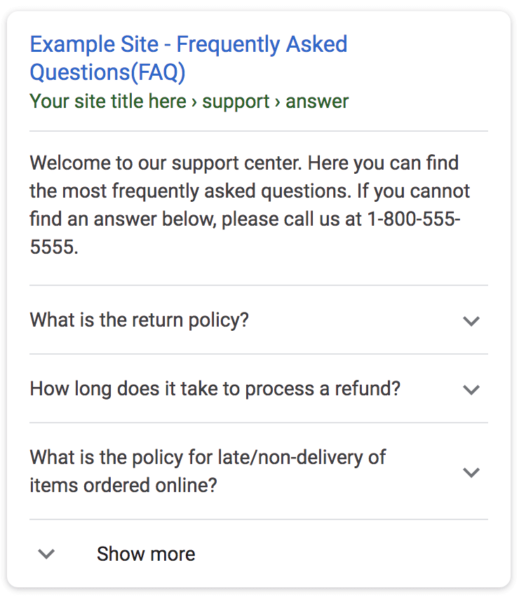
What are rich result FAQs. Web pages that have a list of frequently asked questions (FAQs) that contain a list of questions and answers pertaining to a particular topic can markup the questions and answers with FAQ structured data. Google may then show those FAQs in the search results snippets as illustrated below:

More showing. Google is now showing these FAQ rich results five percentage points more often according to RankRanger, who happened to be recently acquired by Similarweb. Here is the data chart showing the uplift:

SEOs like Brodie Clark and Glenn Gabe noticed the increase too on clients they have access to:

Two links. As a reminder, Google recently limited the number of links you can see within an FAQ rich result to two links. A couple years ago, Google also tightened the guidelines around using FAQ schema on your site.

Why we care. With more FAQ results showing up in Google Search, it may benefit your site if you gained those rich results but at the same time, if your competitor now shows up for these rich results, then it might have the opposite affect. Rich results generally lead to a higher click through rate from the Google search results snippet to the publisher’s site but not always. In this case, if the searcher gets his or her answer from the FAQ rich result, they made not end up clicking over to your site.

So test, test and test to see if you want these FAQ rich results for your site.

The post More FAQ rich results being displayed in Google Search appeared first on Search Engine Land.


from Search Engine Land https://ift.tt/QSAF9mN
via IFTTT

Webinar: Benchmark your social media performance for a competitive edge

Social media benchmarking involves comparing your metrics and processes against the industry standards. Learn how you can get a clear idea of how you stack up against the competition.

Hear from Rival IQ and NetBase Quid experts about the metrics and benchmarks you can use to measure your social media performance.

Register today for “Benchmark Your Social Media Performance For a Competitive Edge” presented by NetBase Quid.

The post Webinar: Benchmark your social media performance for a competitive edge appeared first on Search Engine Land.


from Search Engine Land https://ift.tt/aG4kC3i
via IFTTT

Google releases May 2022 broad core update

Google is now rolling out its first broad core algorithm update of 2022. It is named the May 2022 core update, Danny Sullivan of Google announced.

The most recent core update was the November 2021 core update, over 6 months ago.

The announcement. Google said “today, we’re releasing our May 2022 core update. It will take about 1-2 weeks to fully roll out.”

“Core updates are changes we make to improve Search overall and keep pace with the changing nature of the web. While nothing in a core update is specific to any particular site, these updates may produce some noticeable changes to how sites perform, which we’ve noted in previous guidance on what site owners should know about core updates,” Google added.

Rumors of core updates. The SEO community since May 16 through this week has been seeing signs of a potential algorithm update rolling out. Google has not confirmed those rumors

Any volatility prior to today is likely unrelated to those rumors. Maybe Google was testing this core update?

Rollout started this morning. Google started this broad core update rollout at about 11:30 a.m. ET. And Google will update us when this update is done rolling out.

Previous core updates. The most recent previous core update was the November 2021 core update and prior to that was the July 2021 core update and before that it was the June 2021 core update and that update was slow to roll out but a big one.

Before that, we had the December 2020 core update, which was very big, bigger than the May 2020 core update, and that update was also big and broad and took a couple of weeks to fully roll out. Before that was the January 2020 core update, we had some analysis on that update over here.

The one prior to that was the September 2019 core update. That update felt weaker to many SEOs and webmasters, as many said it didn’t have as big of an impact as previous core updates. You can read more about past Google updates here.

What to do if you are hit. Google has given advice on what to consider if you are negatively impacted by a core update in the past. There aren’t specific actions to take to recover, and in fact, a negative rankings impact may not signal anything is wrong with your pages.

However, Google has offered a list of questions to consider if your site is hit by a core update. Google did say you can see a bit of a recovery between core updates but the biggest change you would see would be after another core update.

Why we care. Whenever Google updates its search ranking algorithms, it means that your site can do better or worse in the search results. Knowing when Google makes these updates gives us something to point to in order to understand if it was something you changed on your website or something Google changed with its ranking algorithm. Today, we know Google will be releasing a core ranking update, so keep an eye on your analytics and rankings over the next couple of weeks.

The post Google releases May 2022 broad core update appeared first on Search Engine Land.


from Search Engine Land https://ift.tt/uIPQX2K
via IFTTT

Spotify, Meta update political ad offerings for 2022 election cycle

Spotify and Meta have made substantial changes to their ad platforms as they brace for the 2022 U.S. midterm elections. These changes will likely impact political ad spending this election cycle.

Spotify brings back political advertising. According to an email sent by Spotify to partners this week:

  • Political ads will be eligible to run across thousands of podcasts on and off of Spotify.
  • Podcasts on the Spotify network will have the ability to turn off political ads.
  • The ads will only run on the Spotify podcast network for now.
  • The ads will not run on the free-streaming music networks.
  • Spotify will only host ads from known political entities (not issue-related groups).

Political advertisers can also target niche audiences using Spotify’s artificial intelligence-driven “contextual targeting.” Spotify says this will allow advertisers to place ads in podcasts discussing relevant issues to reach their target audience.

Spotify stopped running all political ads in 2020 because they couldn’t “responsibly validate” political ads. So what’s changed in 2022?

“We have spent the past two years strengthening and enhancing our processes, systems and tools to responsibly validate and review this content,” a Spotify spokesperson told Protocol.

Meta targeting now includes updated congressional districts. Advertisers will have the ability to target audiences based on U.S. congressional districts. This information will reflect the 2020 census and will be eligible on all ads interfaces and APIs under the “2020-census” notation. As the districts are finalized, they will begin rolling out across Meta for location targeting.

One catch: if a congressional map is in litigation, no targeting will exist for the time being. So advertisers will have to manually target users by way of ZIP code or city.

The previous pre-2020 census information will still be eligible for targeting through the beginning of 2023. All advertisers looking to run ads on Meta properties will still need to be authorized with the proper disclaimers in order to be eligible.

Why we care: As we head into the next election cycle political advertisers will have new opportunities thanks to Spotify, and updated congressional districting on Meta. This should lead to more digital ad spending – and if the Spotify AI works as advertised, a much more custom option for political advertisers.

The post Spotify, Meta update political ad offerings for 2022 election cycle appeared first on Search Engine Land.


from Search Engine Land https://ift.tt/3vlZ4Mu
via IFTTT

Take web hosting to the (NVMe) extreme

Today we live in a world that demands speed, reliability, and security. The reality is that 47% of consumers expect a webpage to load in two seconds or less before they bounce.

Moreover, if you work with heavy-data applications that slow down your site, you are likely to suffer from:

  • Random down-time on your
  • website
  • Slower load time on your
  • website
  • Higher bounce rates
  • Poor SEO ranking
  • Difficulties expanding your
  • website

What does NVMe do?

NVMe, or Non-Volatile Memory Express, is a blazing fast storage protocol that enables users to take full advantage of high-performance flash memory. That is, NVMe uses flash storage to manage large amounts of data to improve the performance of your website.

NVMe helps access what you need more efficiently while improving your website’s loading speeds by 20x more than traditional hard drives.

Benefits of VPS with NVMe

Ultimately, when you put together a Virtual Private Server (VPS) hosted website with NVMe capabilities, you get:

  • A seamless user experience
  • A better handle on data-heavy
  • applications
  • Improved uptime
  • Improved SEO
  • Advanced
  • Scalability

Understanding what a VPS with NVMe can do for you will empower you with the right tools to optimize your website and reach your business goals, whatever they may be.

InMotion Hosting now provides a faster hosting experience and superior technical solutions for our customers. We continue to future-proof our infrastructure by introducing High-Availability and NVMe SSD Storage across our Managed VPS product line.

New VPS customers will be provisioned on NVMe SSD servers. These high-performance and reliable servers provide up to 20x speed and performance over traditional hard disk drives. 

All our VPS plans now include NVMe FREE.

The post Take web hosting to the (NVMe) extreme appeared first on Search Engine Land.


from Search Engine Land https://ift.tt/98AtRxq
via IFTTT

How to audit your site’s backlink profile

There are differing opinions in the SEO industry about whether disavowing links is still a necessary part of SEO.

Some say that Google simply doesn’t count toxic links. Others say that Google still uses the disavow as a means of “policing” spam links. Yet others claim that disavowing toxic links is essential for your site’s health and growth.

I prefer to err on the side of caution and disavow toxic links.

Perhaps, right now, Google simply ignores toxic backlinks. However, what if Google decides to pay attention to these in the future? Google is constantly changing, so what guarantee do we have that toxic links won’t result in manual actions or algorithmic downgrades?

In this article, we’ll explore a step-by-step process to comprehensively audit your backlink profile and keep an updated disavow on file with Google Search Console.


Get the daily newsletter search marketers rely on.

Processing...Please wait.


It’s important to use as many sources as possible to build your initial disavow list. Generally, I download my backlinks from Google Search Console, Ahrefs, and LinkResearchTools. I then upload all of these links to Semrush’s Backlink Audit tool. 

Once your audit runs, you’ll get an Overall Toxicity Score and other important data:

If you click on the Audit tab, you’ll see a list of all of your backlinks. For each, Semrush will list the Anchor Text, Authority Score and Toxicity Score.

Ideally, you should go through each and every one of your links and categorize them as:

  • Whitelist: Safe, healthy links that should be kept as part of your link profile
  • Remove: Links that should be removed. You have to do this by contacting the site owners and requesting for them to remove your links.
  • Disavow: These links should be disavowed from your backlink profile.

Semrush will save this audit and, as new links are found, will prompt you to categorize them, making it easy and systematic to maintain your backlink profile free of toxic links.

In the audit report, click on Toxic Markers. You’ll see a list of patterns that can be used to filter your backlinks:

By using these markers, you can look at your backlink profile in the context of patterns, instead of having to look at your backlinks one by one.

A link might look healthy when analyzed by itself, but when you use the Toxic Markers, you may notice it’s part of a link network, that you have many links from the same C class or that many of them have the same Google Analytics or Google Adsense code.

Start by clicking on each of the sections for toxic markers.

Next, go through the links that show up and label them as whitelist, remove or disavow.

Once you have gone through every pattern, go through the remaining links and use the toxic score and other link details to determine if you should whitelist, remove or disavow the links.

Search for footprints

When analyzing your backlinks, you need to look at the entire context of your backlink profile to make decisions. Also, you may want to audit your competitors’ backlinks as well, especially those that are ranking well, to get an idea of the backlink ratios that are working in your particular industry.

Here are some of the percentages that you can review and keep in mind when deciding how to label links:

Top referring domain categories

Based on your business, the category of internal links is important. Are most of your links coming from:

  • Related, topical websites?
  • Directories or unrelated websites?

Look at the percentages. Compare those to your competitors and use those percentages to help you decide what links to keep or disavow.

Referring domains by authority score

Many people believe that they should disavow all low-quality links or links with low authority scores. However, think of the natural growth of the web.

Is it natural for sites to only gain links from topical, authoritative websites? Think of how many people have small sites that only their close circle follows. 

Looking at link patterns, it’s clear that sites will have a mixture of high, medium and low-quality links. Your goal should be to have links from each of these levels, almost like a link pyramid.

In the “natural state” of the web, you’ll have a number of low-quality links that simply don’t have a lot of authority or that may be toxic. You should keep some of those, especially those that don’t belong to other patterns.

How many of your backlinks are branded? How many of your links use keywords in the anchor text? Monitor this closely as it will reveal patterns.

If your percentage of money anchors is high, this could lead to a suppression of your rankings due to algorithmic Penguin filters. When reviewing your backlinks, disavow some of the links with money anchors to bring those percentages down.

Look at the exact anchor text to identify some that are being overused or look unnatural.

Semrush will allow you to click on the links for each of the charts above, knowing the context of the filter, so you can go straight through and disavow links that belong to a particularly obvious pattern.

When looking at Link Attributes, you can determine if there’s a high volume of follow vs. nofollow links or links from User Generated Content (UGC). A high number of nofollow links is expected. However, if too many of the links are Follow, Sponsored or UGC, you may want to disavow some to even out the percentages.

Review your disavow list

Once you have completed your audit, you can click on the disavow tab to review all of the URLs you added to this list:

Before uploading your disavow to Google, use a metrics tool to get additional data on each of these URLs.

Sometimes, you’ll find that some of the links that have a toxic marker have good metrics and would be acceptable to keep. Scrubbing all of your links one last time will help you make sure you’re not disavowing links that could help your site to rank better.

To decide what links to keep, review the Authority Score, number of keywords ranking, and organic traffic to ascertain if the link should stay in the disavow file or be removed.

Once completed, export your disavow file.

Google disavow file

Once you have your disavow file in a .txt format, you can go to the Google Disavow Tool to upload your disavow file. 

You should run a new backlink audit at least quarterly to make sure your backlink profile is healthy. If you use the same Semrush project, it will save all of the data and will only add new links that haven’t been labeled or categorized. 

Keeping an eye on your backlink profile can signify the difference between thriving traffic or ranking suppression.

Even though Google claims it isn’t possible to suffer from a negative SEO attack, there have been enough reports to prove that it is, in fact, possible for your site to be negatively impacted.

The post How to audit your site’s backlink profile appeared first on Search Engine Land.


from Search Engine Land https://ift.tt/8kElKLW
via IFTTT