Search

Friday, February 23, 2024

Project management for in-house SEO teams: 6 best practices

In-house teams constantly juggle a never-ending pipeline of SEO projects, from competitor analysis and technical maintenance to launching new products and website migrations. Without effective project management, this constant influx of work can quickly become overwhelming. 

This article explores the key elements of successful project management for in-house SEO teams, helping you navigate the constant project flow while supporting broader business goals and focusing strategically on improving organic search performance.

Where did all these projects come from?

Picture this: an SEO project dashboard for a multi-faceted company. At first glance, you will bet that the in-house team suffers from a split personality.

On the dashboard, you’ll see SEO-related tasks such as competitor analysis, topic research and technical maintenance. But mixed in with those are projects for decommissioning product X, launching product Y, and migrating sections from one website to another – a real Frankenstein dashboard. 

But there’s a method to the madness: every change to a website can make or break its organic performance. There is a significant difference between removing dead weight and smart redirections and link management.

The main question is: how can in-house SEO teams transform this complex dashboard into a more strategic one?

1. Fill out the gaps about the ‘what’

SEO experts are sometimes viewed as introverts, hidden behind big Excel tables, strange tools and mumbling incomprehensible words about their “Google god.” 

In reality, in-house SEOs are one of the most communicative teams. They must unearth and comprehend other teams’ plans, including their practical implications, scope and timeline.

Regular meetings

Don’t wait for invitations – be proactive.

Schedule regular meetings with other teams based on their planning pace. Use these sessions to share your projects, listen actively and ask questions.

Understanding other departments’ plans is essential for scoping your SEO work effectively.

Meeting notes

Documenting these meetings is essential to prevent any details from being overlooked.

After each meeting, promptly log all action items in a project management tool.

This enables you to follow up with others while the discussion is fresh in their minds.

Scope of work

Understanding the scope of work is essential for both external projects and SEO initiatives.

Create clear checklists and lists with sub-tasks where these are needed. The clear scope will also improve your time estimations and improve your understanding of how achievable these projects are in a certain time frame.  

Having a good understanding of the “what” and all the planned projects is a good start for your project management, but to make it work, you need to know also the “why.”

Dig deeper: How to build an SEO-forward culture in enterprise organizations

2. Challenge the purpose

Every project on your dashboard should have a clear purpose. If you can’t explain the “why” behind a task to a 5-year-old, it’s back to the drawing board.

This clarity helps prioritize projects effectively, ensuring that your team’s efforts align with broader business goals. 

Don’t be afraid to be the radical candor in the room, but back your behavior with data and a clear approach.

One of the ways is to use the SMART goals tactic and ask the person who has requested the project to fill in the parts:

  • Specific: Clearly articulate what needs to be accomplished one more time.
  • Measurable: Point out how success will be measured – what the core KPIs are.
  • Achievable: Evaluate if the project is realistic while considering limited resources like time and people.
  • Relevant: Double-check if the project matters now or for the short and long-term strategy of the company and how critical it is.
  • Time-bound: Share what is the desired due date and if this due date is fixed because of different circumstances.

You can also use the “5 Whys” method and try to unveil the root cause. People often suggest projects to fix the obvious problem instead of eliminating the root cause.

A real-world SEO example will be logging a project to clean 301 redirects. With good technical maintenance – 301 redirects should be cleaned right after a redirect is placed into your CMS.

So, the root cause is not that there are many 301 redirects. It is the fact that people are not following the process and are redirecting URLs without replacing the internal links. 

Dig deeper: SEO product manager vs. SEO manager: What’s the difference?

3. Find the right priority

One of the most important things for every in-house team is having a clear prioritization matrix. You don’t need an infinite list of rules for each quadrant, but for the critical and highly important ones, this is a must.

The reason is that with a never-ending pipeline of projects, you should know how to explain to other teams why you think their project is not critical and why it will continue waiting on your backlog for better times.

To place each project into the right quadrant, you can start with the following questions:

  • Will the project have a global impact (i.e., for all regions or all websites)? For example, is the business releasing something valid for all markets or something good for one?
  • Are other teams dependable on your deliverables? For example, are they waiting for detailed topic research so that they can plan the local content calendar for the next six months?
  • Are there time limitations not under your company’s control? For example, a project manager from another team has promised that the due date of a project will be date X, versus your company ending its contract with a third-party system, and the business needs to migrate from it until date X?
  • What is the expected ROI of the project? And is the ROI expected short-term or long-term? Is it really measurable?
  • Has the project been delayed by other teams? Or has it been excitingly anticipated for a long time because its goal is to change the current situation?
  • Is the SEO team dependable on the deliverables of other teams? Are they on track or in delay?
  • Who is the main stakeholder of the project? Is this directly coming from the CEO or a C-level manager? This one is tricky. From one perspective, these people usually have more information about the bigger picture than you. But from others, they may also miss some context known by mid-level managers.

Answering these questions will help you understand how important each project is and the level of its urgency, as not all critical projects are urgent. 

For pure SEO projects, you can use a double prioritization matrix approach and define both business and SEO priorities. 

For example, fixing 404 might be critical from an SEO perspective, but is it really critical from a business perspective? It depends. 

  • If it is a wrong link to a product page coming from the navigation, it is. 
  • But if we are talking about 20 links from the blog, it may be with medium or low business priority. 

The SEO priority level will help you better plan the limited time resources you have for pure SEO projects. But how can you keep all this madness organized?

Dig deeper: How to use SEO education for stakeholder management


Get the daily newsletter search marketers rely on.


4. Power up with a tool

There are plenty of tools for project management – Asana, Trello, Monday, Jira, Google Sheets, Excel, to name a few.

It doesn’t matter which one you choose. They all have their pros and cons. What really matters are these five things.

What tools are using the other teams

Make a list of the tools the teams you are usually working with use – Fkend, Web Project Management, etc. Pick the tool that is used the most. It will be easier for big cross-team projects if you all work on the same platform.

This can provide better visibility to the stakeholders and a better overview of the whole project and its progress. Also, if other teams are already using this tool – it is also familiar to the rest of the business. 

Can you log all the needed information?

I am a big fan of tools where you can use custom fields in projects. 

For example, I currently work with Jira and have set some custom fields, including language, SEO area (e.g., is it an on-page improvement or topic research?) and SEO priority. 

By doing so, I can quickly pull reports.

Can you create repetitive tasks?

A big part of the work done by SEO teams is repetitive. You need to check the website for new issues, to provide the business with a monthly report, etc. These repetitive tasks can easily take more than half of your time, so you must plan the rest of the projects accordingly. 

But it is annoying if you need to log them every week and every month. Ideally, the tool you use for project management should do this for you, so all you need to do is set them up once. I have used this functionality in both Jira and Asana, saving me up to an hour every week. 

Can you create different reports?

The tool of choice should give you the flexibility to slice and dice the information related to your projects. If you have a list of 20 projects, it is difficult to calculate the time estimates for all.

 That is why I have created a simple dashboard with a graph showing the total estimated hours for each person on the team. By looking at it and his/her calendar, we can quickly spot if it is realistic to complete everything within the week or if we need to move something to the next one. 

Another use-case is for our bi-weekly meetings with the product departments – we can easily extract just the projects supporting the business goals for this product. 

Can colleagues submit a project for you?

Your project management tool should allow people from other departments to submit projects for the SEO team.

A simple Google or Survey Monkey form can also do the job. But it is easier if these are directly entered into your backlog.

Just don’t overcomplicate this, and don’t make people submit a form for things taking less than 30 minutes of your time.

In my current job, we have dedicated Slack channels for every region. We use them for updates from both teams and questions/answers. If the question is more complicated, we inform the stakeholders that we will log it as a project.

Thanks to the automation of Jira and Slack, creating a project from a channel chat is a matter of clicking a button. It directly posts the link to the task into the channel so that everyone can access it. Asana works the same way. The functionality is also available for email clients (at least for Gmail).

If the tool of choice covers all the above, go for it. Spend enough time in the initial settings, saving you time later. 

The last missing piece for a complete project management process is to identify all the stakeholders of your projects. 

5. Identify the stakeholders

Because of the various projects on which in-house SEO teams work, they need to deal with many different types of stakeholders, from colleagues from development departments to the VP of marketing.

This makes things even more challenging, as different people are interested in different aspects of the project and its related information. It is easy to miscommunicate your projects if you don’t tailor your messaging to the right audience. 

Let’s say you’re working on a project to launch a new language version of the website. You can discuss with the dev teams which website the x-default hreflang tag should lead, but you should ask your business stakeholders which website they consider the main one for the business. 

Both questions will lead to the same answer from an SEO perspective, but if you ask them to the wrong people, this will lead to at least one more one-hour meeting. 

Identifying stakeholders is crucial because the person submitting the project might not always be the final decision-maker. This is especially helpful if you have a couple of projects with similar scope and impact and need someone to make the hard decision. 

I always say that the organization chart of your company is one of your most valuable assets to make sure your project management will work. 

Dig deeper: SEO stakeholder management: When your ‘no’ isn’t enough

6. Adopt agility

This one might not work for all teams, but I will highly recommend it. Agile methodologies enable teams to be more flexible and efficient in a dynamic environment. 

I have tried planning for a month, a quarter, a week, etc. From my experience, what works best is a high-level year roadmap plus detailed weekly sprints. Planning for a week gives you flexibility while the roadmap keeps you on track with your North Star goals. 

High-level roadmaps are also good visibility tools for the C-level. Make sure that these roadmaps are understandable for non-SEO people. Use tools like Miro or Notion and name your projects based on the “why” you are doing them. Make sure that you translate these Whys into business language. 

For teams with more junior members, it is also important to have daily stand-ups or at least some time set specifically for questions and task reviews. This ensures that challenging tasks aren’t overlooked or delayed for long periods, resulting in subpar outcomes. 

Supporting colleagues shouldn’t wait until the sprint ends; with the next sprint starting immediately, time will be tight for new projects.

Don’t plan 100% of your hours. For example, if you have 8 hours of meetings, don’t plan projects for the full 32 hours left in your work week. Plan a buffer of at least 4-5 hours.

Ad hoc requests, chat questions and reading your inbox take time. Having a buffer time gives you the luxury of estimates that are not 100% accurate or for changes in the scope.

If you are the SEO team leader, communicate to your team that having weekly sprints doesn’t mean that you are aiming only at ticking tasks off.

If something requires more time, prolonging it for a couple of sprints is OK. The main goal is that we produce meaningful work.

The art and science of SEO project management

Project management for in-house SEO teams is both an art and a science. It’s not about crossing tasks off a list but about guiding your company’s online presence with vision and strategy.

Remember to support all teams and their goals as you continue playing the cat-and-mouse game with Google. Only by following solid project management principles will you ensure that you won’t drown in the never-ending pile of projects and that you’ll even be able to score some victories.

Dig deeper: Enterprise SEO agency vs. in-house SEO team: What to consider


from Search Engine Land https://ift.tt/SouZhEF
via IFTTT

Google SGE testing and development ongoing and growing

It’s getting harder to find Google Search results that don’t include Search Generative Experience (SGE) results. In three industries (education, B2B tech and ecommerce), SGE appeared on 98% of queries over the past 30 days.

Also, it appears SGE has become active in three new countries: Romania, Poland and Turkey – though Google hasn’t announced this expansion yet.

Those findings (and more below) come from enterprise SEO platform BrightEdge and its Generative Parser, which has been tracking the behavior of Google SGE across 1 billion queries in nine industries.

Why we care. Many SEOs were recently hopeful that Google SGE wasn’t going to happen. However, Google is still investing heavily in the research and development of SGE, testing is continuing and SGE’s footprint is growing, not shrinking. The big questions remains: when will SGE will launch and what the impact will be, industry by industry.

Less “None” SGE states found. When a query doesn’t trigger SGE that is considered a “None” state. It seems we’re moving ever closer to having, well, none of these “nones.”

The shift in “None” states is particularly “dramatic” in three industries, where less than 2% of queries trigger an SGE result:

  • Education.
  • Eommerce.
  • B2B tech.

This likely means Google is satisfied that SGE is delivering value for the users on these queries, according to BrightEdge.

More SGE breakouts. A new version of a “breakout” unordered list is now appearing in SGE. The format includes images, descriptions and sources cited.

More YMYL warnings in SGE. Since January, Google has ramped up the SGE warnings for sensitive topics, such as medical queries. As one example, [broken foot x-ray] includes the warning, “This is for informational purposes only. This information does not constitute medical advice or diagnosis.“:

More Places in SGE. Places, already one of the most common SGE modules, is now showing for 45% of location queries, up from 30% in January. This includes searches related to restaurants and travel.

SGE product viewers. Google has experimented with many formats and seems to have settled on a combination of visual and informational content when these trigger in SGE.

  • The apparel viewer type is the most common one – it includes reviews, prices, images, and the merchant on each tile.

SGE features less Cons. Google has also been testing removing the Cons out of the Pro and Con boxes in SGE. This means searchers will only see pros – and these tests seem to happen for a week at a time, BrightEdge said.

Other experiments. Google has also been testing:

  • An SGE review module, sourced from Google Business Profiles. This module mostly appeared for travel and destination keywords, on less than 1% of keywords.
  • A listen button. So searchers can listen to the answers, part of Google’s push into providing multimodal (text and image) Search and results.

SGE expanding to more countries. Users have started enabling SGE in Search Labs in Romania, Poland, and Turkey. These three countries are not listed on Google’s Where Search Labs & experiements are available page. Even though the lab icon doesn’t appear on the Google homepage, some users have enabled it by going to labs.google.com.

Dig deeper. Google CEO talks future of SGE, Gemini, Ads and AI Search

The report. BrightEdge is now doing live SGE update monitoring as part of its resource, The Ultimate Guide to Google SGE.


from Search Engine Land https://ift.tt/v4xwrqD
via IFTTT

Thursday, February 22, 2024

Google announces Performance Max updates – including Gemini integration

Google announced several update to Performance Max (PMax):

  • Asset generation is expanding globally in English with more languages to come.
  • Image editing will finish rolling out in the U.S. in March, with global English expansion following shortly after. 
  • In the coming weeks, as Google upgrades its image generation models to Imagen 2, you’ll be able to generate lifestyle imagery using PMax that shows people in action. 
  • Ad Strength is changing to help advertisers better understand if they have both the quantity and quality of assets needed to maximize performance. 

Asset generation. In November, PMax introduced AI-powered asset generation and image editing. This tool makes it easier to create text and image assets for campaigns. Leveraging Google’s AI model Gemini, PMax can now write longer headlines, with sitelink generation set to be rolled out soon as well.

Imagen 2. In a few weeks, Google is updating its generation models to Imagen 2. With this update on PMax, you will be able to create lifestyle images showing people in action. You can also use image editing to add backgrounds with non-identifiable people. And, if you have images that work well, you will be able to generate more options to scale your creative even further.

Ad Strength. Moving forward, the quantity and diversity of assets will play a more significant role in determining Ad Strength for Performance Max campaigns. This adjustment acknowledges the crucial role these factors play in maximizing the benefits from the wide range of inventory and formats offered across Google channels.

Why we care. You can leverage these new features to enhance the quality of your ad creatives and optimize your campaigns more efficiently.

What Google is saying. Pallavi Naresh, Group Product Manager, Google Ads, said in a statement:

  • “Performance Max campaigns serve across all of Google’s ad inventory, unlocking more opportunities for you to connect with customers.”
  • “It’s important to have a wide variety of creative assets that meet the needs of different customers and formats. Great creative drives results — we found that advertisers who improve their Performance Max Ad Strength to ‘Excellent’ see 6% more conversions on average.”

Get the daily newsletter search marketers rely on.


Deep dive. Read our Performance Max guide for more information on how it can drive conversions and maximize ROI.


from Search Engine Land https://ift.tt/j4WyY5h
via IFTTT

Report: Reddit signs AI content licensing deal with Google

Now we know – Google is the unnamed AI company that Reddit reached a content licensing deal with, Reuters reported.

Why we care. Reddit was already facing backlash among SEOs because Google appears to be favoring the platform in the Discussions and forums SERP feature. Reddit is even outranking original sources of content in some instances.

Now the question some people will naturally ask: did Reddit get all this valuable visibility in Google’s super-valuable search results because of, or partially due to this deal? Or is the heavy presence of Reddit in Google Search results an attempt at a correction following multiple stories about how searchers are appending Searches with “reddit”. (Or could both these things be partially true?)

The deal. Google is reportedly paying Reddit $6 million per year to train its artificial intelligence models (e.g., Gemini). However, neither Reddit nor Google have officially commented on the deal.

  • On Feb. 16, Bloomberg (subscription required) first reported that Reddit had reached a deal with “a large AI company.”

Making them pay. Reddit made it clear last April they wanted AI companies (e.g., Google, Microsoft, OpenAI) to pay for using its content. Well, now it appears Google is doing just that. Steve Huffman, founder and chief executive of Reddit, told the New York Times (subscription required):

  • “The Reddit corpus of data is really valuable. But we don’t need to give all of that value to some of the largest companies in the world for free.”

Rankings jump. Meanwhile, as Glenn Gabe posted on X, the number of URLs ranking in Google jumped from 22 million between last May and 41.1 million today, according to Semrush data:

  • “That’s a massive jump… i.e. It’s not just rankings that improved, it’s the pure number of pages ranking.”

Here’s Gabe’s full post:


from Search Engine Land https://ift.tt/nNZhJC5
via IFTTT

Link building in 2024: 12 ways to win or fail

As search engines have become more sophisticated, the strategies for effective link building have evolved. 

In 2024, the focus has shifted from quantity to quality, with a greater emphasis on acquiring high-quality, authoritative backlinks from relevant and trustworthy sources. 

This article explores 12 key dos and don’ts for successful link building, highlighting common mistakes to avoid and effective SEO strategies to employ.

1. Don’t: prioritize quantity over quality

More is not better. Better is better. A focus purely on volume is detrimental to your rankings and credibility. 

Remember, Google values the quality and relevance of backlinks over sheer volume. One high-quality backlink from an authoritative website has more impact on rankings than multiple low-quality backlinks. 

Be sure to focus on building relationships with authoritative and relevant sources for impactful link acquisition.

2. Don’t: Neglect the relevance of linked content

While acquiring backlinks from any source may be tempting, this harms your website’s credibility and rankings. 

Building links from irrelevant websites can undermine your site’s credibility and rankings. For example, if you operate a law firm, acquiring backlinks from technology blogs or travel websites may not be as beneficial as securing links from legal publications or industry-specific directories. 

3. Don’t: Publish thin content

In the quest for more content, many are tempted to publish thin or low-quality pieces to drive frequency over quality. 

Google and other search engines won’t reward content that isn’t valuable to visitors. 

Instead, be sure to focus on creating high-quality, informative, and engaging content that addresses the needs and interests of your audience. 

The quality of your content is more impactful for your visitors and rankings over poor content publishing more frequently. 

Remember to conduct thorough research, provide unique insights, and ensure your content is original, well-written and well-structured. Use surveys to gather your own data and provide insights that are easy to digest or provide a different point of view. 

4. Don’t: Over-optimize anchor text

Anchor text optimization is important, but don’t overdo it. 

Exact match anchor text is when you use the exact keyword or phrase you want to rank for as the clickable link text. Google recognizes this as an attempt to manipulate rankings.

Focus on using a diverse range of anchor texts that are relevant to the content being linked. Incorporate variations, branded anchor text, and natural language phrases. 

This approach can also help you rank for broader keywords and attract relevant but diverse audiences.

5. Don’t: Ignore local SEO 

Local SEO is a great opportunity to increase your backlinks, but many companies miss this step. 

Especially for businesses with a local audience, geo-targeted link building will help you increase your website’s local search visibility and be more relevant to your target audience. 

Work to obtain links from business listing websites, local blogs and local directories. 

6. Don’t: Ignore personal connections

Start with who you know. You likely have personal connections in your industry who can help deliver valuable backlinks

So many marketers overlook their own network as a resource, focusing solely on cold outreach and missing out on opportunities for more natural, relevant links. 

Go through your LinkedIn connections and ask. 


Get the daily newsletter search marketers rely on.


Content is at the heart of an effective backlink strategy. Create valuable, engaging, and shareable content to attract high-quality backlinks, including infographics, research results, case studies and surveys. 

Citing statistics and percentages is also important, so focus on creating content that showcases your expertise and provides rare, insightful data. Use long-form content to provide in-depth information or problem-solving features. 

Don’t forget to promote your content through email, social media, and outreach efforts to attract natural backlinks from other websites.

Dig deeper: How to create a link building strategy

8. Do: Guest post on niche-relevant websites

We still love a great guest posting strategy. For 2024, be sure that your guest posts are from highly relevant, reputable and high-authority sites that align with your industry. 

First, identify websites that closely relate to your niche, have similar a target audience, and have a domain authority of 50+. 

Then, reach out to these websites and pitch valuable content ideas that align with their audience’s interests and needs. 

When guest posting, aim to secure “dofollow” links back to your site within the author bio or content. 

9. Do: Harness the power of social proof

Encouraging social sharing of your content can attract backlinks organically. 

As content gains social media traction, it increases the likelihood of other websites referencing and linking to it. 

Creating shareable content, engaging on social media, and using user-generated content (UGC) amplifies your brand’s relevancy and authority.

Dig deeper: How to integrate user-generated content into your SEO strategy

10. Do: Pick up those unlinked mentions

You’ll often find that your website or brand was mentioned on a site, but no link was associated with it. Don’t sleep on those opportunities.

Brand monitoring tools like Talkwalker, Critical Mention or BuzzSumo can help you find unlinked mentions, providing opportunities for easy link building.

In these situations, reach out to the site owner and politely request they add a link to your site. 

11. Do: Focus on strategic content partnerships

Co-marketing and strategic content partnerships are effective ways to leverage the authority and following of other industry blogs. 

Identify authoritative industry blogs and establish partnerships based on mutual benefits. 

Find a topical article on their blog where you can link back to your content and offer to link to their relevant articles.

By partnering with trusted blogs, you can expand your reach, gain more backlinks, and enhance your website’s authority.

Don’t overlook this crucial technique. 

Audit your site’s internal structure and identify pages, posts, or assets that can be linked internally based on topical relevance.

Link from blog posts to related service pages, from product pages to relevant buying guides and blog content, and across navigation menus and site footers. 

Internal link build will enhance the user experience and help search engines crawl and understand your site’s structure.

Avoid common mistakes, embrace winning strategies

Focus on creating high-quality, linkable content, building relationships with reputable sources, and avoiding common link building mistakes. 

Understand that link building is a long-term effort requiring consistent monitoring and effort. 

If you’re reading these best practices and thinking, “I’m just overwhelmed.” Don’t stress. 

Link building is time-consuming, but reputable consultants and agencies can support you and make the process effective and efficient. 

Adopting these practices will improve your website’s visibility and boost its SEO performance in the long run.


from Search Engine Land https://ift.tt/LOzKemP
via IFTTT

Location targeting in Google Ads: Balancing automation and control

Google Ads has evolved significantly in recent years, with more automation and artificial intelligence being introduced to simplify campaign management. 

One area where PPC advertisers now have to make strategic decisions is geotargeting – whether to let Google’s algorithms determine where ads are shown based on performance data or to set specific geographic targets manually. 

This article explores key considerations for optimizing location targeting in Google Ads campaigns. It covers factors like: 

  • Aligning targeting with product/service availability in different regions.
  • Connecting geotargets to localized landing pages.
  • Assessing performance differences across locations.
  • Balancing automation versus manual control. 

With clear guidelines and example data, this guide will help you find the right geotargeting approach for your unique business needs.

What to consider before targeting locations in Google Ads

Does your business have specific products or services by location?

This question is fairly straightforward and fundamental, but if a product isn’t available at a location, you should exclude it from targeting. 

How many times have you, as a consumer, seen an ad, and you know it’s not available in your location? It’s frustrating for consumers and a waste of funds for advertisers.

Maybe your products and services are the same across regions, but there might be specific landing pages or site experiences that require geotargeting the campaign. Geotargeting is set at the campaign level, but landing pages are set at the ad group or keyword level. Therefore, decisions must be made. 

A key to recall here is Google has two location settings

  • “Presence”
  • “Presence or interest” 

Presence means the user is physically present in that location at the time of the search. 

Interest means the user is outside of the physical target but has shown interest in that area in the past. For example, I live in the suburbs but often go into the city. If a business located in the city only shows ads to those in the city, they would miss people like me who are in the burbs but are interested in businesses located in the city.

Google recommends more broad geotargeting as a best practice.

“While broad geo targeting is recommended as a best practice on Search, it’s important to know when targeting for “Presence” makes sense. You should consider “Presence” targeting in instances when:

  • Your business falls within a sensitive vertical with strict targeting limitations.
  • You only want to target users in specific locations and not users who may be in other locations but are still interested in your product or service.”

Dig deeper: Improve your Google Ads performance: 3 simple setting changes

Do you see outsized performance variance?

This topic is more tricky and requires testing. It makes sense logically if a business is set up geographically and budgets are allocated accordingly to set up geotargeted campaigns.

This would allow you to control budgets at the campaign level. However, when data can be aggregated across multiple regions, Google Ads can determine how to allocate those budgets based on the most likely to convert. 

Why is this tricky? Because there isn’t a right answer.

We’ve tested this across multiple companies, verticals, and brands. The answer isn’t always the same. It depends on the specific business, competitive environments, and budget levels as key inputs. 


Get the daily newsletter search marketers rely on.


Real-life examples where geotargeting went both ways 

We had a lead generation business where budgets were allocated by region. This forced us to spend money where it wasn’t as efficient. 

So, we made the case to move to consolidating the campaigns and removing the regional budget allocations. This had an incredible impact on the campaigns, which are detailed below. Right away, we saw massive gains. CPA was down by 32%, and we increased leads by 26%.  

Location targeting for lead gen results

However, performance differences across businesses often necessitate reallocating spend or removing it from certain regions. The data below shows the top five best and worst-performing states based on cost per conversion and spend. 

Location targeting - Ranked by cost per conversion and spend

You can see that the best and worst-performing states in cost per conversion are five times different.

In the example above, Kentucky is 50% lower than the average cost per conversion and is responsible for 1% of spend. If you could reallocate 1% of spend from the highest cost per conversion state (Colorado in this data set), you would reduce cost per conversion materially. 

When looking at the biggest and lowest spend states, it makes sense that they are close to or on average since they account for 10% of spend.

In this case, you would consider just taking out the lowest spend states above the average cost per conversion so that spend could be reallocated. 

This becomes even more important when your budget is small or the data for those specific states is limited.

Data = power to make better and faster decisions. This is especially true for geotargeting. 

Geotargeting in Google Ads: Balancing automation and control

Optimizing geotargeting in Google Ads is crucial for campaign efficiency and effectiveness. There’s no universal approach.

Finding the right balance between automated algorithmic targeting and manual control depends on your business, products/services, localized requirements, performance data, and testing. 

Use data to guide the optimization process, aiming for the ideal mix of automation and granular location control. Through analysis and testing, you can leverage geotargeting tools to enhance ROI and achieve your marketing goals.

Dig deeper: A PPC guide to privacy-focused audience targeting


from Search Engine Land https://ift.tt/MKyUGIA
via IFTTT

Wednesday, February 21, 2024

9 of the best custom GPTs for SEO in the GPT store

OpenAI’s ChatGPT has proven to be a game-changing tool for SEO professionals. As Google has indicated an increased willingness to allow AI-generated content to rank and OpenAI has released new versions of GPT for enterprise use, the use cases have only expanded exponentially.

In January 2024, another monumental shift occurred when OpenAI declared the GPT store open for business. ChatGPT Plus users and those with access to Team and Enterprise plans can explore custom GPTs developed by almost anyone.

Mirroring the strategy used by Apple and Google’s mobile app stores, the platform provided by OpenAI is meant to empower users to build upon their existing product with custom features and experiences for specific use cases. Ultimately, OpenAI plans to introduce a payment model based on user engagement for app developers and creators. 

This article delves into how SEO experts use ChatGPT and provides insights into the most popular custom GPTS available now and how they’re being integrated into overall SEO strategies. 

How are SEO professionals using ChatGPT?

In the three-month window between when OpenAI introduced the ability to create custom GPTs and the launch of the official GPT store, more than 3 million custom versions of ChatGPT were created by users. 

SEOs are leveraging this AI technology for various tasks, including content creation, keyword research, and technical optimizations.

ChatGPT’s ability to understand and generate human-like text makes it a powerful tool to use in all phases of the content creation process. At the same time, its natural language processing (NLP) capabilities can assist in keyword discovery and strategy formulation. 

What are ChatGPT plugins?

ChatGPT plugins, or “GPTs,” are “custom versions of ChatGPT that combine instructions, extra knowledge, and any combination of skills,” according to OpenAI.

While OpenAI’s app store model is similar to that of Apple or Google, the barrier to entry is lower. Anyone can build their own GPT without any coding required, and they can be for personal or internal company use or released to the public. 

Opening a custom GPT will look similar to current ChatGPT users, as they are built off the same text interface and involve the same back-and-forth conversational experience of the traditional model. 

Building off the platform’s capabilities, GPT developers can also define custom actions by making APIs available to the GPT. This means GPTs can access external data, making them even more powerful tools for “real-world” research and integration. 

To list a GPT in the GPT store, the creator must verify their builder profile by making their name visible or linking to a website. 

Dig deeper: How ChatGPT plugins can up your SEO game

How to enable custom GPTs

As of writing, OpenAI’s GPT Store is accessible to:

  • Users who have a ChatGPT Plus subscription, priced at $20/month.
  • Users on the business-oriented plans, ChatGPT Team and Enterprise, with pricing ranging from $25 to several thousand dollars per user per month.

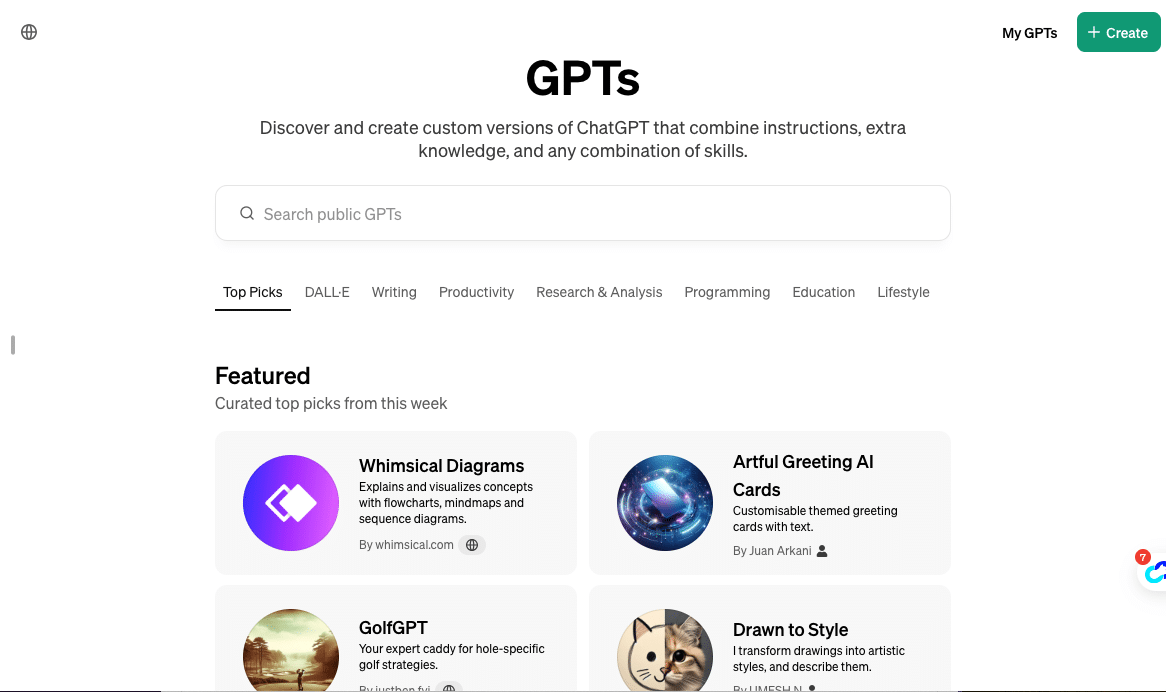
Once logged in, users can access the GPT store and browse leaderboards and popular apps across categories like writing, productivity, DALL-E image generation and more.

Downloading a custom GPT is simple: simply click on the one you desire and it will open in a new window. 

Just like the traditional GPT experience, previous conversations will be remembered and can be returned across sessions. Clicking the app-specific logo will launch a new conversation with the custom GPT. 

Custom GPTs - The GPT Store

Get the daily newsletter search marketers rely on.


Custom GPTs for SEO

Here are some of the most popular and useful custom GPTs developed for SEO professionals, along with descriptions and examples of what they can do.

Note that the list of GPTs available is constantly updating as new developers sign on and OpenAI rolls out new features regularly.

1. Automated Writer by OctaneAI 

Crafts well-written, optimized and researched content in your unique voice. Input your content topic, target keywords, tone of voice, past content examples and goal of your piece, and this GPT will output your desired copy, sourced by research with Bing. 

Automated Writer by OctaneAI

2. Bramework SEO Booster by Bramework

An SEO-focused blogging assistant offering insights into keywords, search volume, rankings, and SERP features. It can enhance SEO strategies with related keyword analysis and can turn YouTube videos into blog and social media posts.

Bramework SEO Booster by Bramework - Prompt

3. SEO by Elevate

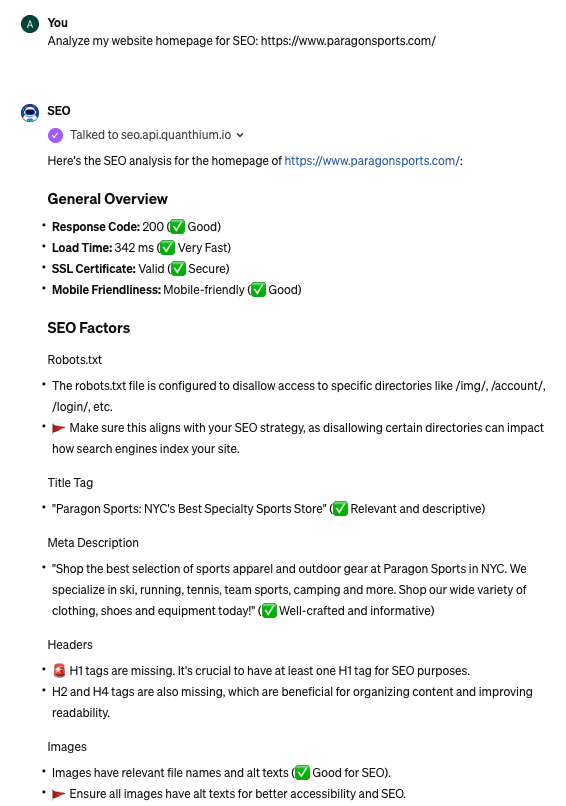
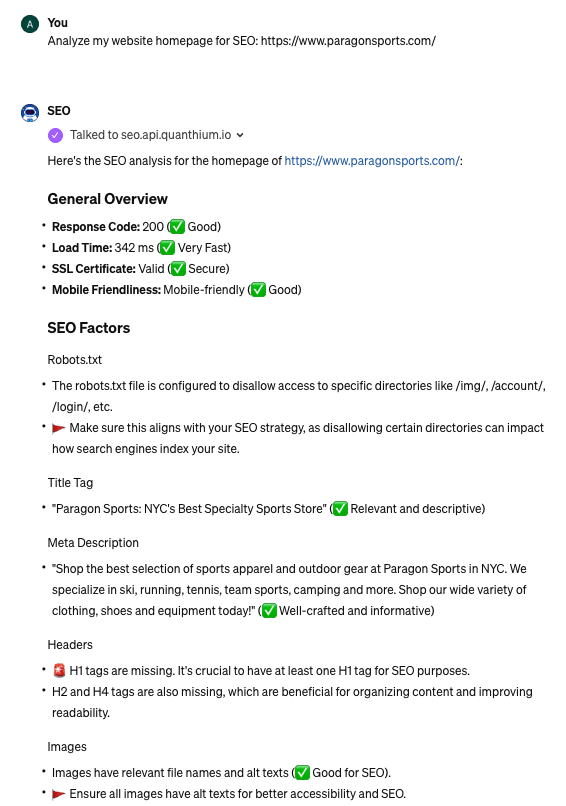
Enter any URL, and this GPT will generate a full on-page SEO analysis with insights to optimize headings and content for any keyword. It reviews the loading time, identifies broken links, conducts image analysis and checks whether your website is mobile-friendly and has a valid SSL certificate.

SEO by Elevate

4. Outrank Article by aiseo.ai

Beat your competitors at their own game. Enter the URL of the article you wish to outrank and receive back an in-depth SEO analysis designed to rank higher. 

Outrank Article by aiseo ai

5. FAQ Schema Markup Generator by Brian Wylie

Structured data markup is key to ranking pages within Google SERP features and SGE responses. 

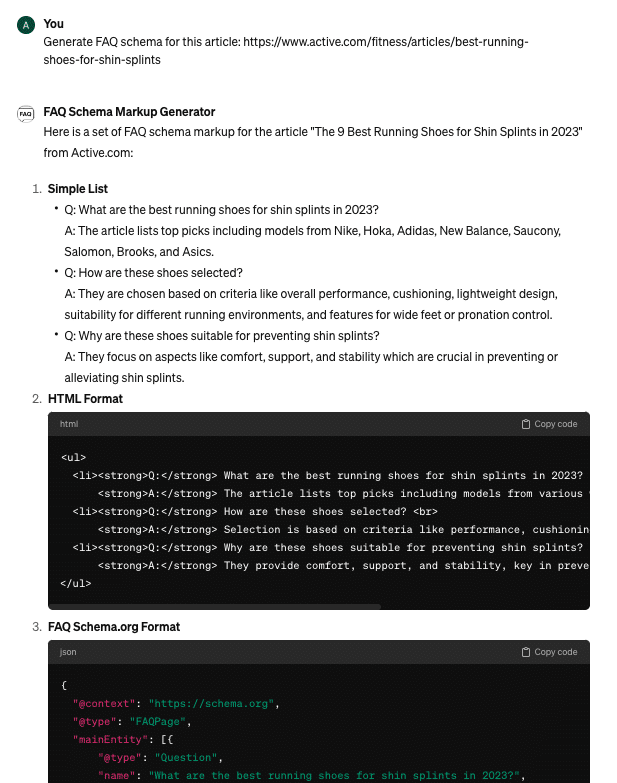
With this GPT, you can generate schema FAQs for webpages by pasting a single URL. It provides FAQs in a simple list, HTML or FAQ Schema Markup.org format for articles, blog posts and product pages.

FAQ Schema Markup Generator by Brian Wylie

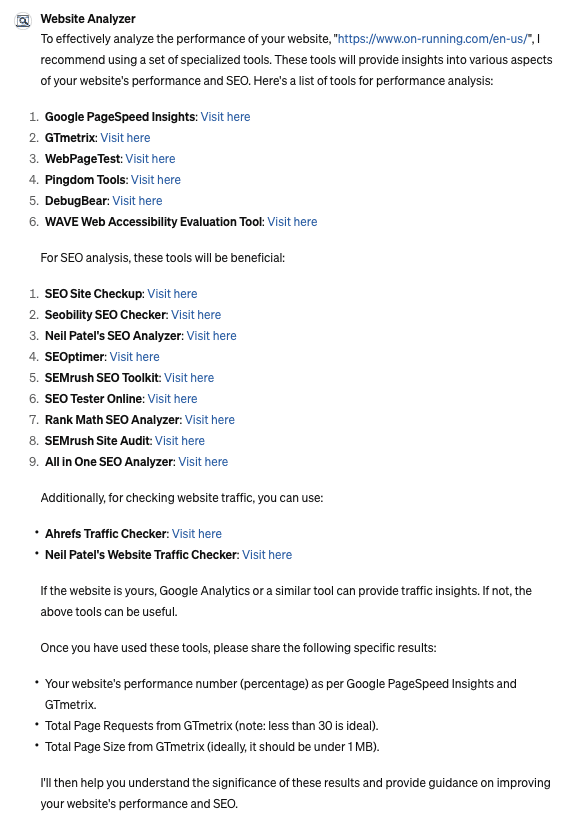
6. Website Analyzer by ARTURS MEDNIS

This is a great tool for starting work on a new domain. You can receive analysis and explanation of a website’s performance, SEO, and UX metrics, focusing on Web Vitals.

This GPT will provide links to the best tools for specific analyses and help you understand the significance of results when inputted. 

Website Analyzer by ARTURS MEDNIS

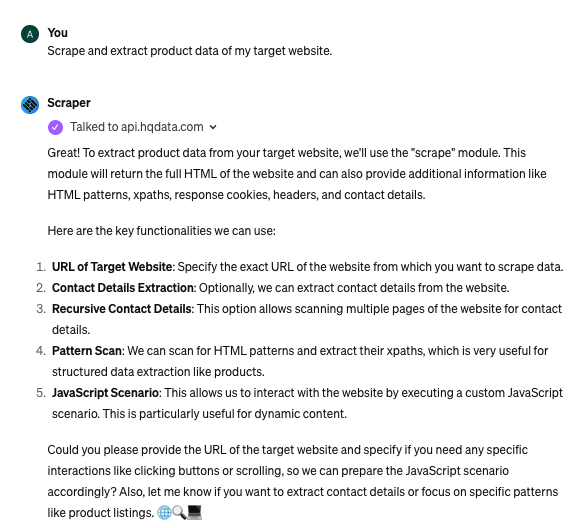
7. Scraper by hqdata.com

This scraper can help you efficiently perform complex web scraping tasks with the capability of scraping dynamic content.

Extracting this data helps you track the page ranks of competitors and understand their content strategy better.

Scraper by hqdata.com

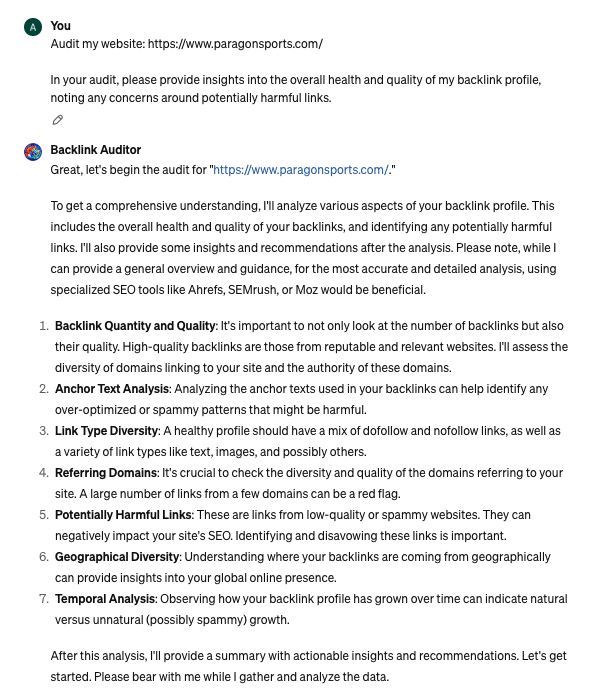
Expert in backlink audit, analyzing and optimizing SEO backlink strategies for enhanced profile quality and actionable insights.

Backlink Auditor by intelliminds ai

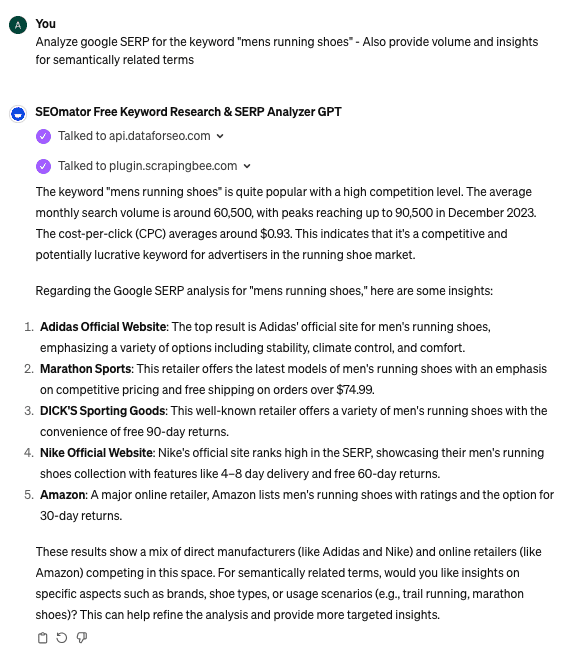
9. SEOmator Free Keyword Research & SERP Analyzer GPT by seomator.com

This comprehensive GPT scrapes Google for real-time search volume data, identifies optimal keywords for SEO, analyzes search engine results page rankings, and evaluates on-page SEO metrics.

SEOmator Free Keyword Research & SERP Analyzer GPT by seomator

Enhancing your SEO strategy with custom GPTs and the GPT Store

Integrating ChatGPT plugins and other AI tools for SEO tasks has already begun to reshape the landscape, offering unprecedented efficiency and deeper insights.

This holds especially true for competitor research and the ability to understand how your crucial competition is evolving its SEO strategy.

As a general best practice, always remember that when it comes to GPTs, the quality of your output depends on the quality of your input. Experimenting and perfecting your prompts is vital to maximizing any of these custom GPTs. 

Dig deeper: 5 SEO use cases for ChatGPT’s Advanced Data Analysis plugin


from Search Engine Land https://ift.tt/8jCdv7q
via IFTTT